
A glass of warm gelatin water does not look revolutionary.
Pale, slightly glossy, and almost suspiciously ordinary. Yet online sellers market this simple mixture as a metabolism booster.
They also pitch it as a remedy for belly fat.
Some call it a natural GLP-1 treatment.
Others claim it can fix every hard relationship people have had with food.
The real story is quieter.
A gelatin recipe for weight loss may help some people manage hunger. It can replace a higher-calorie snack. It can also help you pause before a meal.
Those small effects can be useful. But gelatin does not burn fat directly.
It does not target the waist. It does not detoxify the body. It also does not match prescription weight-loss drugs.
That distinction matters. It allows the recipe to remain practical without forcing it to perform miracles.
The Quick Answer
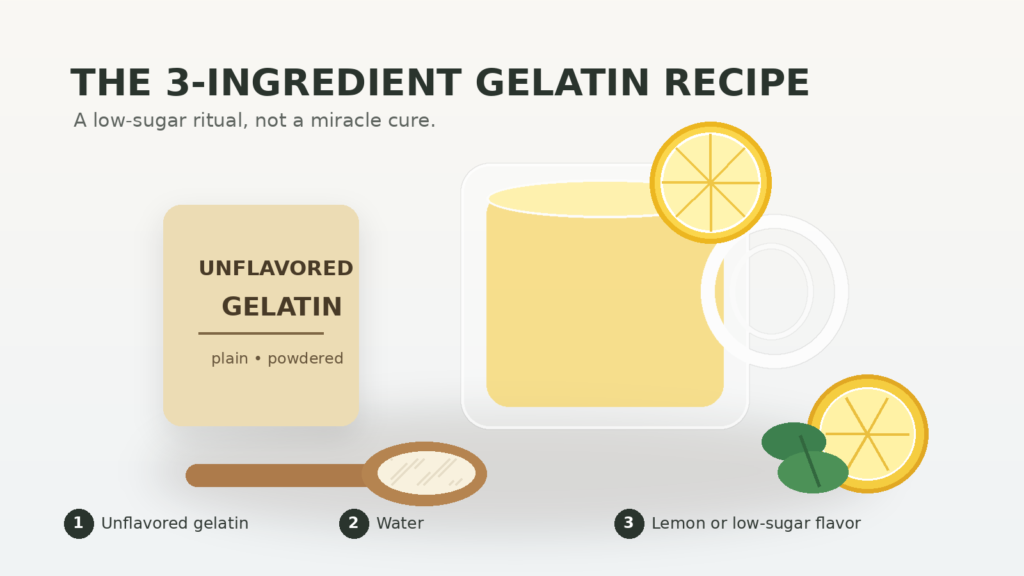
The basic three-ingredient gelatin recipe contains:
- Unflavored powdered gelatin
- Water
- Fresh lemon juice or another low-sugar flavoring
You can drink it warm before the gelatin sets or refrigerate it to make a softly textured snack.
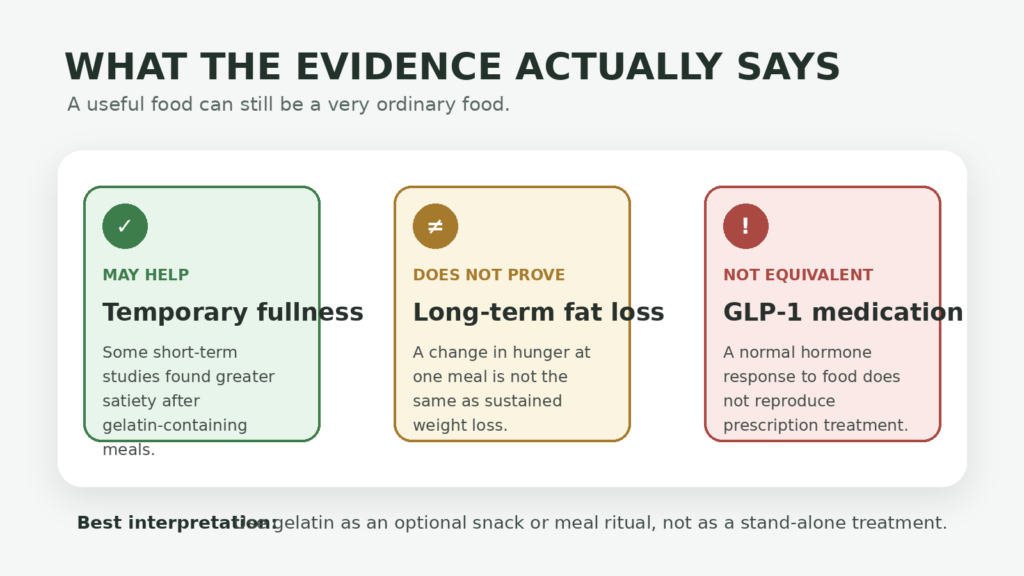
Some short-term research suggests that gelatin-containing meals may suppress appetite. However, longer research has not found a unique benefit for maintaining weight loss. Therefore, you should view gelatin as an optional appetite-management tool, not a stand-alone treatment.
The 3-Ingredient Gelatin Recipe
This version is intentionally uncomplicated. No blender. No expensive supplement stack. No mysterious powder presented by someone whispering beside a kitchen island.
Recipe Details
Preparation time: 5 minutes
Optional chilling time: 2 to 4 hours
Yield: 1 warm drink or 2 small chilled portions
Texture: Lightly thickened while warm and softly set when chilled
Ingredients
- 1 to 1½ teaspoons unflavored powdered gelatin
- 1 cup water, divided
- 1 to 2 teaspoons fresh lemon juice
Optional: A small amount of stevia, monk fruit, or another preferred sweetener.
How to Make It
1. Bloom the gelatin
Pour ¼ cup of cool water into a heat-safe glass, mug, or bowl.
Sprinkle the gelatin slowly over the surface. Try to distribute it evenly rather than dropping the powder into one dense pile.
Leave it untouched for three to five minutes. The gelatin will absorb the water and develop a thick, soft appearance.
We call this step blooming. It helps the powder dissolve smoothly, instead of forming small rubbery clumps.
These clumps cling to the spoon with surprising determination.
2. Heat the remaining water
Heat the other ¾ cup of water until it is steaming but not aggressively boiling.
Pour the hot water over the bloomed gelatin.
3. Stir until completely dissolved
Stir for 30 to 60 seconds.
The mixture should look smooth, with no dry granules sitting at the bottom or floating near the surface.
4. Add the lemon
Stir in one teaspoon of fresh lemon juice. Taste the drink before adding more.
Lemon adds acidity and aroma, so you may find that the recipe needs less sweetener than expected.
5. Drink it warm or chill it
For a warm gelatin drink, let the mixture cool until it is comfortable to sip.
For chilled gelatin, divide it between two small containers, cover them, and refrigerate for two to four hours.
Because gelatin strength varies between products, check the manufacturer’s directions when you want a particular firmness.
What Is the Gelatin Weight-Loss Trick?
The “gelatin trick” is not a standardized medical treatment or scientifically established weight-loss protocol.
People use an informal name for several drinks and snacks made with unflavored gelatin. People consume most versions shortly before a meal or use them as a low-calorie alternative to dessert.
You may also see it called:
- The three-ingredient gelatin recipe
- The pre-meal gelatin drink
- The pink gelatin trick
- The Jell-O weight-loss recipe
- Bariatric gelatin
- The gelatin hunger trick
- Natural GLP-1 gelatin
- A natural Ozempic alternative
These phrases do not necessarily describe the same product.
Plain gelatin mixed with lemon water differs in nutrition from flavored dessert mix.
The flavored mix often contains sugar, sweeteners, coloring, and other additives. A recipe shared in a bariatric community is not automatically suitable for every patient or every stage of recovery.
And a food that triggers an ordinary digestive-hormone response is not equivalent to a prescription medicine.
Remove the promotional language, and the idea is easier to judge.
Gelatin is a low-calorie ingredient that contains protein.
It may make some people feel fuller for a short time.
Can Gelatin Significantly Help With Weight Loss?
Possibly, but its value is indirect.
The recipe may be helpful when it:
- Replaces a higher-calorie dessert
- Reduces unplanned snacking
- Creates a defined portion
- Slows the beginning of a meal
- Helps intense hunger feel less urgent
- Adds structure to an eating routine
The important word is replaces.
A light gelatin cup may reduce calorie intake when it replaces cake, ice cream, or another energy-dense snack. If you eat it in addition to the usual dessert, you simply add it to the meal.
What Gelatin Cannot Promise
Evidence does not show that a homemade gelatin drink:
- Directly burns body fat
- Selectively removes belly fat
- Detoxifies the body
- Causes rapid weight loss
- Replaces nutritionally balanced meals
- Guarantees lasting weight control
- Works like prescription GLP-1 medication
A food can be modestly useful without becoming a biological event.
What the Research Found
Some controlled studies have examined how gelatin-containing meals affect hunger and later food intake.
In one comparison between gelatin and casein diets, gelatin produced greater appetite suppression. Casein, however, supported a better protein balance because gelatin is an incomplete protein.
Another breakfast study found that gelatin meals led to lower energy intake at lunch than other protein breakfasts. The researchers studied specific controlled meals, not the small lemon-and-water drink promoted online.
These findings suggest that gelatin can influence short-term fullness under particular conditions.
They do not prove that drinking gelatin every morning causes meaningful fat loss.
Feeling Full Is Not the Same as Losing Weight
Appetite is only one part of weight management.
Someone can feel fuller after breakfast and still consume the same total calories across the rest of the day. Sleep, stress, activity, food availability, medication, health conditions, habits, and personal preferences continue to influence what happens after the initial feeling fades.
A four-month study tested whether a gelatin-rich diet helped people keep weight off after an eight-week weight-loss period. It found no unique long-term weight-maintenance advantage for the gelatin intervention.
The most accurate interpretation is therefore simple:
Gelatin may reduce hunger for a short time in some people. But researchers have not shown that it causes lasting weight loss on its own.
Is Gelatin a Complete Protein?
Gelatin contains protein, but it is not a complete protein.
Complete proteins provide all nine essential amino acids in adequate proportions. Gelatin lacks a balanced essential amino acid profile. It should not replace eggs, dairy, fish, meat, soy, or well-mixed plant proteins.
This becomes important when people promote the gelatin recipe as breakfast or lunch.
Plain gelatin lacks sufficient fiber, essential fat, vitamins, minerals, and balanced protein to function as a complete meal.
It works better as:
- A small snack
- A light dessert
- A pre-meal drink
- One ingredient in a more substantial recipe
Combining gelatin with Greek yogurt can make a more filling snack, because yogurt adds complete protein and extra nutrients.
Does Gelatin Increase GLP-1?
GLP-1 is a naturally occurring hormone involved in appetite, digestion, insulin release, and blood-glucose regulation.
One small study gave a flavored, sweetened hydrolyzed gelatin meal with 20 grams of gelatin.
The study included 12 participants with obesity and 10 lean participants. Researchers observed a rise in plasma GLP-1 and insulin after consumption.
That finding does not mean gelatin works like a GLP-1 receptor agonist medication.
Many foods cause digestive hormones to rise after eating. Scientists design prescription GLP-1 medicines to act on specific receptors at controlled doses for extended periods. You cannot recreate their pharmacology, clinical effects, side-effect profiles, or medical supervision by dissolving gelatin in water.
Calling this drink “natural Ozempic” is therefore misleading, even if it looks excellent in a social-media caption.
Why the Drink May Still Feel Filling
The effect may come from several small factors working together.
It Creates a Pause
Preparing the drink interrupts the direct journey from hunger to food.
Blooming the gelatin, heating the water, stirring, and waiting for it to cool creates a short gap. During that pause, hunger can become something you notice rather than something you immediately obey.
It Adds Volume
A cup of liquid temporarily increases stomach volume.
Water can do this too. Gelatin adds some protein and changes the texture, which may make the drink feel more substantial.
Texture Slows You Down
A lightly thickened drink or chilled gelatin cup takes longer to consume than a few fast sips of water.
That slower pace can make a small serving feel more noticeable.
It Gives the Portion an Ending
A small gelatin cup has a clear beginning and end.
That clear boundary may help people who struggle to control open bags and family-sized containers. This is understandable, since many packages seem made for a family of twelve. They also seem made for one distracted adult.
When Should You Drink It?
No proven time exists at which gelatin suddenly begins causing fat loss.
Many people drink it 15 to 30 minutes before lunch or dinner. This may create a useful routine, but it is not a scientifically established metabolic window.
Before a Meal
This timing may suit people who arrive at meals ravenous and eat fast during the first few minutes.
Between Meals
A chilled gelatin cup can replace an unplanned snack. It may not be as satisfying as fruit with yogurt, nuts, eggs, cottage cheese, or another option with protein and fiber.
After a Meal
Gelatin can also work as a light dessert, particularly when the goal is to replace a richer sweet.
Loading the mixture with juice, honey, syrup, sugar, and toppings makes the benefit smaller.
Three Easy Flavor Variations
Pink Berry Tea Gelatin
Replace the plain water with unsweetened hibiscus or berry tea.
The tea creates a natural pink or ruby color without relying on sugary juice or food coloring.
Green Tea and Citrus Gelatin
Use brewed green tea and add lemon or lime zest.
Choose decaffeinated tea in the evening or when caffeine interferes with sleep.
Greek Yogurt Gelatin Cups
Dissolve the gelatin in a small amount of hot water and allow it to cool slightly. Whisk it gradually into plain Greek yogurt.
This creates a creamy, mousse-like snack with complete protein.
Gelatin, Jell-O, and Collagen Are Different
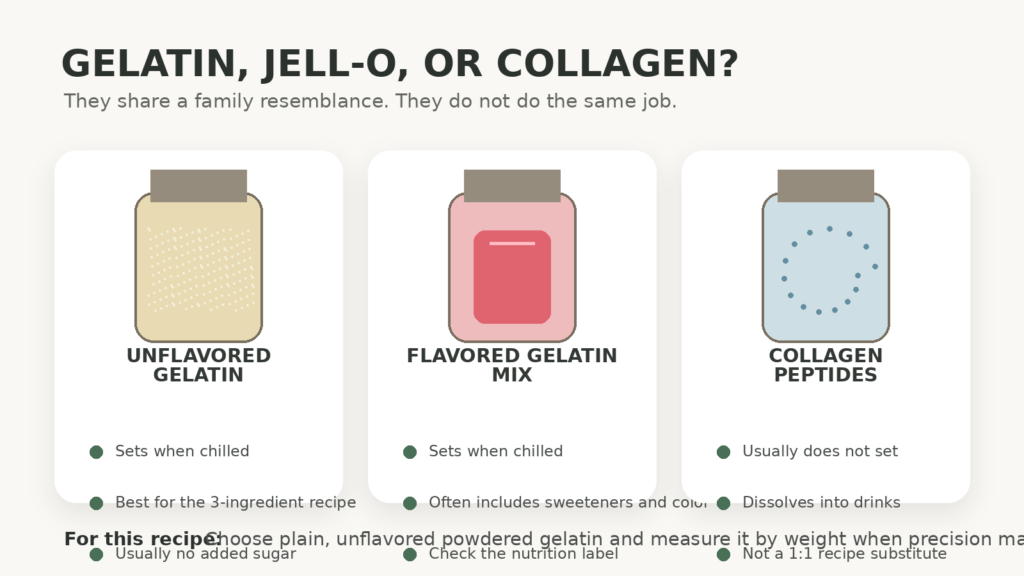
Unflavored Gelatin
Plain gelatin thickens liquids, sets when chilled, and usually contains no added sugar. It offers the most control over flavor and sweetness.
Flavored Gelatin Mix
A flavored dessert mix may contain sugar, low-calorie sweeteners, colors, flavors, acids, and other additives.
It may still be low in calories, but it is not identical to plain gelatin.
Collagen Peptides
Collagen peptides usually dissolve without forming a firm gel. They may work in coffee, smoothies, and yogurt, but they are not a direct substitute in recipes that need to set.
Agar-Agar
Agar is a plant-derived gelling ingredient. Suitable for vegetarian and vegan recipes, but requires different preparation and creates a firmer, more brittle texture.
Safety and Sensible Use
Many adults can consume normal food amounts of gelatin without difficulty, but tolerance varies.
Begin with a small serving and stop if it repeatedly causes nausea, bloating, digestive discomfort, or another unwanted reaction.
Check the source if you have allergies or follow religious, vegetarian, or vegan dietary restrictions. Manufacturers make traditional gelatin from animal collagen.
Consult an appropriate healthcare professional before making major dietary changes if you:
- Have a medical condition
- Take medication affected by food or meal timing
- Are pregnant or breastfeeding
- Have undergone bariatric surgery
- Have difficulty swallowing
- Follow a prescribed diet
- Have a history of disordered eating
- Are receiving medical treatment for obesity
The CDC notes that weight management depends on nutrition, activity, sleep, and stress. Health, medicines, genes, hormones, age, and the environment also shape it. It also reports that people maintain gradual weight loss of around one to two pounds per week more successfully than faster loss.
Questions You May Still Be Asking
Will this burn belly fat?
No. Gelatin does not selectively remove abdominal fat.
How much should I use?
Begin with one teaspoon for a lightly thickened drink or 1½ teaspoons for a softer chilled snack. Follow the product directions when you need a firm set.
Can I use sugar-free Jell-O?
Yes, but it contains different ingredients from plain gelatin. Check the label for sweeteners, colors, serving size, and additives.
Can collagen powder replace gelatin?
Not when the recipe needs to set. Collagen peptides generally dissolve without creating the same gel structure.
Can I drink this instead of breakfast?
Plain gelatin is not a balanced meal. It lacks adequate fiber, essential fat, complete protein, and a broad range of micronutrients.
Why didn’t mine set?
Common causes include too much liquid, too little gelatin, incomplete dissolving, inadequate chilling, or accidentally using collagen peptides instead of gelatin.