
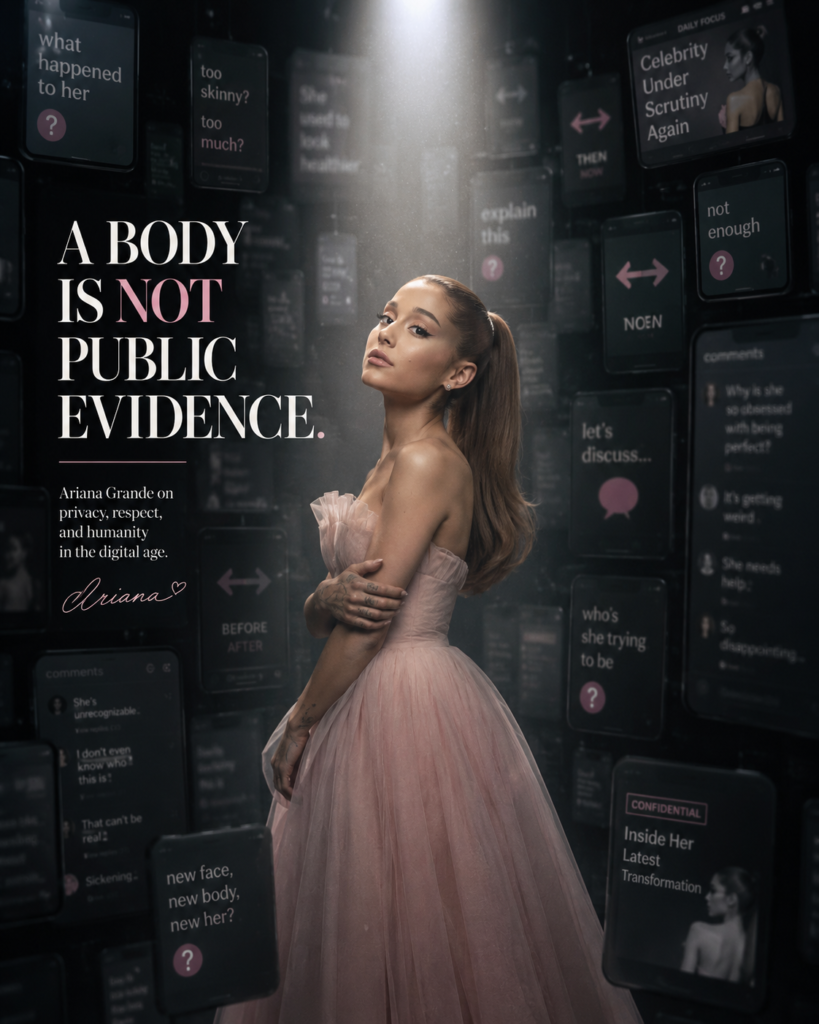
For years, people have studied Ariana Grande’s appearance as though her body were a public document waiting to be decoded.
A photograph appears. Someone places it beside an older one. Within hours, strangers are debating diets, medications, illnesses, stress, cosmetic procedures and supposed warning signs. The theories multiply faster than the facts.
Yet Ariana Grande has never announced a public weight-loss journey. She has not revealed a target weight, promoted a transformation plan or explained her appearance through a diet, workout routine or prescription drug.
What she has done is ask people to stop treating other people’s bodies as open invitations for analysis.
That distinction changes the entire story.
The direct answer: Ariana Grande has not publicly shared a verified weight-loss method. She has spoken about the harm caused by appearance-based speculation and explained that an earlier version of her body, which many people described as healthier, actually reflected a deeply unhealthy period in her life.
Why the Search for “Ariana Grande Weight Loss” Became So Intense
Interest in Ariana Grande’s weight did not begin with a formal announcement. It grew from visual comparison.
Fans and entertainment accounts began placing recent photographs beside images from earlier stages of her career. Some viewers believed she looked thinner. Others commented on her face, posture, clothing or overall appearance. Soon, ordinary observation hardened into confident explanation.
She must have changed her diet.
She must have lost weight for a role.
She must be using medication.
She must be unwell.
The language varied, but the assumption underneath it remained the same: if her body looked different, the public deserved to know why.
The conversation became even louder during the promotional cycle for Wicked. Grande was appearing frequently at premieres, interviews and photographed events, often beside co-star Cynthia Erivo. Every new outfit or camera angle created another round of commentary.
But a photograph can only show what was visible in a fraction of a second.
It cannot reveal a medical history. It cannot explain sleep, stress, nutrition, grief, medication, recovery or emotional well-being. It cannot tell us whether a physical change was intentional. It cannot even show a person’s body with complete accuracy, since lenses, lighting, posture, styling and image selection all shape what the viewer sees.
The image is public. The explanation is not.
Internal link opportunity: Link “celebrity before-and-after photos” to a guide about camera angles, lighting, styling, editing and visual comparison bias.
The 2023 Video That Changed the Meaning of the Conversation
In April 2023, Ariana Grande addressed the discussion directly in a TikTok video.
She did not sound eager to enter the debate. In fact, she explained that she preferred not to speak publicly about her body at all. Still, the volume of commentary had reached a point where silence was being filled with increasingly invasive theories.
Her first request was broad and deliberate: people should become less comfortable commenting on other people’s bodies.
Not only cruel comments. Not only insults.
All of them.
Grande pointed out that even remarks presented as compliments can land painfully. Telling someone they look healthier, thinner, fuller, prettier or “better than before” may seem harmless to the person saying it. But that comment rests on assumptions about what the person has lived through.
The speaker sees a body.
The person receiving the comment remembers the life attached to it.
The Body People Praised Was Linked to Her Lowest Period
The most revealing part of Grande’s statement concerned the older photographs people kept using for comparison.
Many viewers had described that earlier version of her body as healthier. Some said she looked better then. Others used those images as evidence that something must now be wrong.
Grande said they had misunderstood what they were seeing.
According to her, that earlier appearance coincided with what she considered the unhealthiest period of her life. She said she had been taking antidepressants, drinking while using them, eating poorly and living through a profound personal low.
The photographs people were praising carried a reality they could not see.
That disclosure dismantled the comforting logic of the before-and-after collage. The public had looked at two images and decided which version represented health. Grande had lived inside both versions, and her assessment was the opposite of theirs.
This is why the Ariana Grande weight-loss conversation cannot be reduced to whether she looks thinner.
The deeper issue is the confidence with which people turn appearance into evidence.
“Healthy Can Look Different”
Grande’s central point was not that health has no relationship to the body. Nor was she claiming that all visible changes should be ignored.
Her message was more precise: health does not always look the way strangers expect it to look.
A person may appear energetic while struggling privately. Another may look different because they are recovering, aging, changing routines or simply living through circumstances that do not belong to the public.
Grande also reminded viewers that the person being discussed may already be receiving support. They may be speaking with doctors, therapists, family members or trusted friends. The fact that strangers have not been given an explanation does not mean no one is paying attention.
Sometimes, what looks like public concern is simply public curiosity wearing softer clothes.
What Ariana Grande Said During the Wicked Press Tour
The subject returned in December 2024 during an interview with Ariana Grande and Cynthia Erivo.
When the conversation turned toward beauty standards and public criticism, Grande became visibly emotional. She described growing up under constant inspection and said she had felt like a specimen in a Petri dish since she was about 16 or 17.
That image captured something ordinary celebrity coverage often hides.
Grande was not speaking about one isolated rumor. She was describing years of having her face, clothes, makeup, hair and body treated as material for public correction.
When one feature changed, people criticized the change. When it did not change, they criticized that too.
The rules were impossible because they were never really rules. They were an endless invitation for strangers to evaluate.
Why She Called Body Speculation Dangerous
Grande took particular issue with the certainty behind online comments.
People did not merely say she looked different. They tried to explain the difference. Some speculated about illness. Others discussed medication, nutrition or mental health. The absence of facts rarely slowed the conversation.
This is the part of celebrity culture that can appear harmless until the same behavior happens in an ordinary room.
Imagine a family member announcing that someone looks too thin during dinner. Imagine a colleague asking about weight loss in front of coworkers. Imagine a friend being told that their old body looked healthier, with no knowledge of what they were experiencing at the time.
The scale may be different online, but the intrusion is familiar.
Grande argued that people had become dangerously comfortable discussing bodies that were not their own. Whether the remark reached a celebrity through millions of posts or an ordinary person through one careless conversation, the emotional impact could still be real.
By that point, she said, she had learned to protect herself more deliberately. She relied on relationships, creative work and a stronger internal sense of value rather than allowing every public opinion to enter her private life.
This was not a revelation about how she lost weight.
It was a statement about who gets access to her.
Why the Message Returned Again in 2025
In November 2025, Grande reshared clips from the 2024 interview on Instagram Stories.
She framed the repost as a friendly reminder not to comment on other people’s bodies.
The timing mattered because it showed that her earlier remarks were not a temporary response to one news cycle. Her position had remained consistent.
Across several years, Grande had returned to the same ideas:
- Appearance cannot reveal a complete picture of health.
- A positive-sounding body comment can still be intrusive.
- Concern does not create a right to private information.
- People should be more careful about turning visual changes into public theories.
The message barely changed.
The speculation, because humanity remains stubbornly committed to missing a point delivered several times, continued anyway.
Has Ariana Grande Explained How She Lost Weight?
No verified public weight-loss method has been disclosed.
Ariana Grande has not presented her appearance as a transformation campaign. She has not published a calorie plan, a workout schedule or a timeline showing how much weight she lost.
She has not publicly shared:
- A starting weight
- A current weight
- A target weight
- A calorie deficit
- A macronutrient breakdown
- A weight-loss medication
- A named trainer responsible for a transformation
- A diet plan created for fans to follow
- A specific number of pounds lost
- A commercial weight-loss program
What she has shared is personal context about one earlier period in her life.
That context should not be reverse-engineered into a diet strategy.
When Grande explained that she had been eating poorly and drinking while taking antidepressants, she was not giving readers a wellness blueprint. She was correcting the false belief that the body people preferred represented greater health.
Turning that disclosure into a weight-loss article would erase the meaning of what she said.
Ariana Grande Weight-Loss Claims: What Is Confirmed and What Is Not
Online claimWhat the public record actually showsVerdictAriana Grande announced a weight-loss journeyShe addressed comments about her appearance but did not promote a transformationUnsupportedShe revealed exactly how much weight she lostNo verified amount has been disclosedUnsupportedShe shared the diet that changed her bodyNo specific weight-loss diet has been confirmedUnsupportedShe used Ozempic or another GLP-1 drugGrande has not publicly confirmed thisUnverifiedShe lost weight for WickedShe has not identified the role as the cause of a weight-loss programUnverifiedHer appearance proves she has a particular illnessA diagnosis cannot be made from photographsUnsupported and inappropriateShe said an earlier version of her body reflected an unhealthy periodGrande stated this directly in 2023ConfirmedShe has asked people to stop commenting on bodiesShe made this request repeatedly between 2023 and 2025Confirmed
There is an important difference between false and unverified.
A false claim has been disproved. An unverified claim has not been supported by reliable evidence.
The distinction may seem small, but it matters enormously in celebrity health reporting. Writers often turn “not confirmed” into “probably true” simply because the same theory appears across dozens of posts.
Repetition creates familiarity.
It does not create proof.
Internal link opportunity: Link “Ozempic and celebrity rumors” to a medically reviewed article explaining why prescription medication use should never be inferred from appearance.
Did Ariana Grande Lose Weight for Wicked?
Ariana Grande has not publicly confirmed that she followed a weight-loss program for Wicked.
The speculation grew partly because her changing appearance was discussed heavily during the film’s promotion. Viewers saw her repeatedly at press events and connected the timing with her role as Glinda.
But timing is not evidence of cause.
Actors may change routines while working. They may also experience ordinary changes unrelated to a production. Without a direct statement, there is no factual basis for claiming that Grande lost weight for the role.
Her own comments make this boundary especially important. She has repeatedly criticized the habit of constructing private explanations from visible appearance.
Claiming to know why her body changed would repeat the exact behavior she asked people to reconsider.
Has Ariana Grande Confirmed Using Ozempic?
No verified public statement confirms that Ariana Grande used Ozempic, Wegovy, Mounjaro or another GLP-1 medication for weight loss.
The rumor follows a familiar pattern.
A celebrity appears thinner. Social-media users search for an explanation. A popular medication provides a specific and emotionally satisfying answer. The theory spreads because it feels more complete than uncertainty.
But a detailed rumor is still a rumor.
Prescription medication is private medical information unless the person chooses to disclose it. Facial appearance, body shape and red-carpet photographs cannot establish whether someone uses a particular drug.
It would also be inaccurate to make the opposite claim and state with certainty that Grande has never used one.
The responsible conclusion is narrower:
Ariana Grande has not publicly confirmed GLP-1 medication use in connection with her appearance or weight.
Why Photographs Cannot Tell Us Whether Someone Is Healthy
A photograph can reveal that someone looked a certain way in a certain moment.
That is where its authority ends.
Health is shaped by medical history, nutrition, sleep, stress, emotional well-being, physical function, medication, genetics and countless other factors. Most of that information remains invisible.
Even the visible elements of a photograph are unstable.
The way a body appears may shift because of:
- Camera angle
- Focal length
- Lighting
- Shadows
- Posture
- Movement
- Clothing structure
- Makeup
- Hairstyling
- Cropping
- Editing
- Image compression
- The exact frame selected from a video
Before-and-after images are especially persuasive because they create a story without having to prove one.
Two photographs are placed beside each other. The dates are added. The viewer’s brain begins searching for a cause.
One picture becomes “before.” The other becomes “after.” The layout quietly tells us that a transformation occurred, even when the surrounding circumstances are unknown.
Grande’s 2023 comments exposed how easily that visual story can fail.
The appearance people associated with health was, in her own account, connected to a period of emotional and physical struggle.
The photograph was real.
The interpretation was wrong.
When Concern Turns Into Another Form of Body-Shaming
Not every comment about Ariana Grande’s weight is openly cruel.
Some sound worried.
“She looks too thin.”
“I hope someone is helping her.”
“She looked healthier before.”
“Is she eating enough?”
The intention may be compassionate. The effect can still be invasive.
Each statement turns a visible body into a public medical discussion. Each assumes that strangers can identify a problem and understand its cause without access to the person’s life.
Concern becomes especially questionable when it is performed publicly for engagement. Reposting close-up images, circling body parts or inviting followers to debate a possible diagnosis does not provide care.
It provides content.
Why Compliments Can Hurt Too
Body commentary does not become harmless merely because the words sound positive.
“You look so much better now.”
“You were perfect at that weight.”
“You look healthy again.”
These statements can tie a person’s worth to a particular appearance. They may also praise a change caused by grief, illness, stress or another private experience.
The speaker sees improvement.
The person hearing the comment may remember pain.
Grande’s story makes this contradiction unusually clear. The body others praised was associated, for her, with one of her lowest periods.
The compliment and the truth were pointing in opposite directions.
Internal link opportunity: Link “how to compliment someone without mentioning weight” to a body-neutral communication guide.
What Ariana Grande Has Never Claimed
Responsible coverage also requires attention to what Grande did not say.
She has not claimed that every person commenting on her appearance is malicious.
She has not argued that concern for another human being is always inappropriate.
She has not said that physical changes never deserve medical attention.
She has not suggested that weight has no relationship to health.
She has not claimed that her experience applies to every person or every body.
Her position is more measured than that.
People should stop treating visual impressions as complete knowledge. They should be careful about assigning diagnoses, habits or private struggles to someone based on appearance alone.
That principle works in both directions.
It is irresponsible to declare that a person is unhealthy because of a photograph. It is equally irresponsible to guarantee that the person is healthy.
Neither conclusion can be supported from public images.
Why Celebrity Bodies Become Public Mysteries
Celebrity culture has a predictable relationship with physical change.
A body changes, or appears to change, and the transformation is treated as a puzzle.
There must be a hidden diet.
A demanding role.
A breakup.
A medication.
A health crisis.
A trainer.
A secret.
Humans are uncomfortable with unfinished stories. When two photographs look different, the brain searches for the missing bridge between them.
Social platforms intensify that instinct. The creator offering the most dramatic explanation often receives more attention than the person admitting that the answer is unknown.
Certainty performs well.
Accuracy is slower and less theatrical.
Grande’s comments disrupted that familiar narrative because she refused to provide the expected reveal. Instead of explaining how her body changed, she questioned why strangers felt entitled to an explanation.
Visibility Is Not the Same as Ownership
Ariana Grande’s music, films, performances and interviews are public because she has chosen to share them as part of her work.
Her medical records are not.
Neither are the private circumstances surrounding every visible change.
Fame creates access to a person’s image. It does not create ownership of the person.
That boundary becomes easier to understand when removed from celebrity culture. Most people would recognize the cruelty of demanding that a coworker explain weight loss in front of an office. They would hesitate before asking a neighbor whether medication caused a change in appearance.
Online, the audience becomes so large that the same behavior begins to feel normal.
Grande’s repeated statements argue that it should not.
What Readers Can Learn Without Copying Ariana Grande’s Body
The useful lesson is not how to look like Ariana Grande.
There is no confirmed routine to reproduce, and another person’s appearance is not a sensible measurement of personal health.
The more valuable lesson is about how easily we confuse seeing with knowing.
Health Is Not a Visual Ranking System
Looking different does not reveal whether someone is doing better or worse.
A photograph cannot show bloodwork, sleep quality, mental health, nutritional status, physical strength or daily functioning.
Those details belong to the person living inside the body.
Nobody Owes the Internet a Medical Explanation
Bodies change for ordinary reasons and extraordinary ones.
Age, stress, recovery, work, medication, grief, illness, relationships, routine and genetics may all play a role.
A person may choose to discuss those changes. They may also choose not to.
Privacy does not become suspicious merely because curiosity remains unsatisfied.
Celebrity Commentary Reaches People Who Are Not Celebrities
When thousands of posts describe one body as frightening, unattractive or unacceptable, the message does not stay attached to one famous person.
It reaches readers with similar faces, weights and body types.
Someone watching the discussion may recognize their own shape in the insults. Another may begin questioning whether their body is allowed to exist without explanation.
That is part of what makes celebrity body commentary broader than gossip. The target may be famous, but the standards being enforced reach everyone.
Sometimes Kindness Looks Like Restraint
Grande’s request was striking because it was simple.
People rarely know the full story behind another person’s body. They should speak with more care.
In an online culture built around reaction, analysis and endless commentary, saying less can feel almost unnatural.
It may also be the more humane choice.
How to Judge Celebrity Weight-Loss Stories Before Believing Them
Celebrity health stories are often written to feel more certain than the evidence allows.
Before trusting one, ask a few basic questions.
Did the Celebrity Say It Directly?
A verified interview, video or first-person statement is stronger than anonymous sourcing, fan speculation or image comparison.
Even then, context matters. A comment about body-shaming should not be repackaged as a detailed explanation of weight loss.
Does the Headline Go Further Than the Evidence?
A headline may claim that a celebrity “revealed” a secret diet when the article contains nothing more than old quotes about food preferences.
Look for the gap between what the title promises and what the source actually says.
Is the Story Diagnosing Someone From a Photograph?
Words such as unhealthy, sick, underweight or medicated carry medical implications.
Without clinical information or a direct disclosure, those labels should not be treated as facts.
Is the Article Selling the Alleged Solution?
Be especially cautious when a celebrity rumor leads directly to supplements, meal plans, coaching programs or affiliate products.
A common formula works like this:
- Create fear around a celebrity’s appearance.
- Claim to understand the cause.
- Sell the reader a supposed version of the solution.
The commercial motive is not proof that every claim is false. It is a reason to inspect the evidence more closely.
Does the Writer Admit What Is Unknown?
Trustworthy reporting uses clear boundaries.
“Ariana Grande said…”
“She has not confirmed…”
“No reliable evidence establishes…”
Those phrases are not signs of weak writing. They are signs that the writer has resisted turning uncertainty into fiction.
Internal link opportunity: Link “how to fact-check celebrity health stories” to a practical media-literacy checklist.
Frequently Asked Questions
Why did Ariana Grande lose weight?
Ariana Grande has not publicly explained her appearance as a defined weight-loss journey. She has asked people not to infer health, medication use or private circumstances from photographs. Any specific explanation remains unverified unless Grande confirms it herself.
Did Ariana Grande say why she looks thinner?
She has discussed the public reaction to her appearance, but she has not provided a complete medical or lifestyle explanation. Her main point was that viewers cannot determine whether someone is healthy by comparing images from different periods.
What did Ariana Grande mean when she said she was unhealthy before?
Grande said that the older body many people described as healthier was connected to a difficult period when she was eating poorly, drinking while taking antidepressants and experiencing a personal low. She shared this to demonstrate why visual judgments can be misleading.
Has Ariana Grande revealed her current weight?
No verified current weight has been disclosed in her public statements.
What diet did Ariana Grande use to lose weight?
Grande has not released a verified diet plan explaining her appearance. Articles that assemble a supposed routine from old interviews, food preferences or fan theories should not be treated as confirmation.
Did Ariana Grande lose weight for Wicked?
She has not publicly confirmed a weight-loss program connected to Wicked. The overlap between public discussion and the film’s promotional period does not prove that the role caused a physical change.
Did Ariana Grande use Ozempic?
Ariana Grande has not publicly confirmed using Ozempic or another GLP-1 medication for weight loss. Medication use cannot be reliably inferred from facial appearance or body size.
Is Ariana Grande healthy now?
Her current health status is private. Public photographs and interviews cannot provide enough information to confirm or deny a person’s medical well-being.
Why does Ariana Grande look different in some photos?
Appearance can vary because of real physical changes, but also because of lighting, makeup, hairstyle, clothing, posture, camera lenses and image selection. Grande has not provided a complete public explanation, and she is not required to.
What is Ariana Grande actually asking people to do?
She has repeatedly encouraged people to become less comfortable commenting on other people’s bodies. Her message centers on restraint, kindness and the recognition that appearance does not reveal the full story.
Is it safe to copy a celebrity weight-loss routine?
A routine based on rumors, photographs or reconstructed interviews is not a reliable health plan. Nutrition, exercise and medical decisions should be based on individual needs and professional guidance, not an attempt to reproduce a celebrity’s appearance.